NASA has selected seven companies for contract awards under the Mars Exploration Program’s Science Transport and Robotic Innovation for Deployment and Exploration (STRIDE) initiative to advance next-gen commercial robotic surface mobility for future Mars exploration.
The STRIDE awards will support the development of innovative robotic mobility systems that may enable future Mars missions to access more challenging terrain, travel greater distances and investigate scientifically valuable regions that are difficult to reach with current mobility systems.
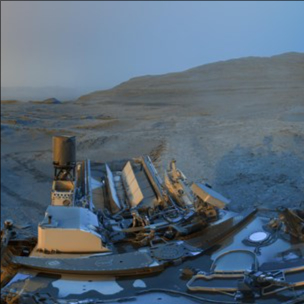
As reported by Mark Carreau in a July 2026 Aviation Week article, NASA currently has two rovers actively exploring Mars. Curiosity landed in August 2012 to investigate changes in the environmental habitability of Mars over time, while Perseverance touched down in February 2021 with the Ingenuity drone helicopter to seek evidence of past biological activity. Three previous NASA Mars rovers—the Mars Pathfinder Sojourner and the Mars Exploration Rovers, Spirit and Opportunity — landed in 1997 and 2004. Though successful, they struggled with issues that included mobility in the Martian sand and dust storms that inhibited solar power generation.
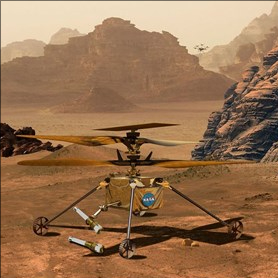
The mobility failures that STRIDE is meant to solve — rovers mired in soft sand, solar arrays choked with dust and mass budgets too tight for redundant systems — are problems composites have already been used to address elsewhere in Mars and Moon missions hardware. Carbon fiber composite rotor blades enabled Ingenuity to fly in an atmosphere less than 1% as dense as Earth’s while composite pressure vessels cut mass from Nova-C’s lunar landing-proven propulsion system. Composite rover wheels have also been engineered, at nano-rover scale, for the same loose-regolith traction problem NASA cited when describing Spirit and Opportunity’s struggles.
Source | NASA