Firefly Aerospace (Cedar Park, Texas, U.S.) has received a $13 million subcontract from NASA’s Jet Propulsion Laboratory (JPL) to manufacture, test and deliver the aeroshell for NASA’s SkyFall mission to Mars, targeted for launch in late 2028. The SkyFall mission, managed by JPL, will deploy three heritage Mars helicopters to perform science and demonstrate airborne subsurface mapping and resource prospecting, paving the way for U.S. astronauts on Mars.
“NASA’s SkyFall is Firefly’s first award coming out of our new Gloworks innovation lab, which embodies our commitment to developing disruptive space technologies without disrupting our existing production lines,” says Shea Ferring, Firefly CTO. “Our expertise in building large composite structures for both spacecraft and rockets gives us an advantage to enable critical planetary missions like SkyFall. We’re further innovating these core technologies through Gloworks to push the boundaries of what’s possible and open new frontiers across our solar system.”
The SkyFall aeroshell, comprising both the backshell and heatshield, will be developed within the Gloworks innovation lab and manufactured at the company’s Rocket Ranch in Briggs, Texas. Firefly will use carbon fiber composites — the same materials used on its Blue Ghost lunar landers, Elytra orbiters and Alpha and Eclipse launch vehicles.
Following manufacture, Firefly will complete rigorous structural qualification and flight acceptance testing to ensure the SkyFall aeroshell meets all mission requirements for the harsh environments encountered during launch, cruise and Mars entry, descent, and landing. The company will then deliver the aeroshell to JPL for additional environmental testing at JPL’s facilities prior to integration with JPL’s SkyFall helicopters and deployment system.
Built on the success of NASA’s Ingenuity Mars helicopter, the SkyFall helicopters will be deployed using an innovative mid-air release technique known as the “SkyFall Maneuver.” This technique uses an entry capsule to release the three helicopters during descent, eliminating the need for a landing platform. The helicopters will then fly to the surface and capture high-resolution surface imagery and subsurface radar data. This data will be used to obtain a better understanding of the terrain and natural forces that shaped the landing site and scout for water ice.
Firefly reports significant progress across multiple missions to the Moon, including four upcoming lunar missions as part of NASA’s Commercial Lunar Payload Services (CLPS) initiative. Firefly also recently received a JPL subcontract to deliver four drones above the lunar south pole with its Elytra spacecraft in support of NASA’s MoonFall mission.
The company continues to ramp up spacecraft production and recently doubled the size of its facilities in central Texas and expanded its spacecraft cleanroom to enable an assembly line of lunar landers and orbital vehicles in support of multiple missions a year to the Moon and beyond.
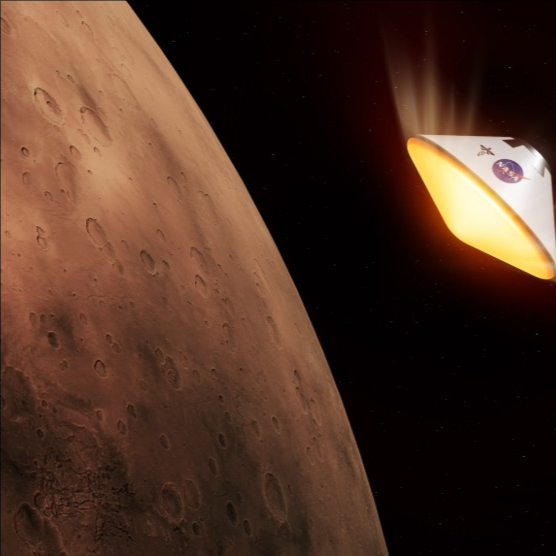
Rendering of aeroshell for NASA SkyFall mission to Mars. Source | Firefly Aerospace